
In today’s hyper-connected world, news of employees striking for better pay and working conditions makes headlines with predictable frequency. While these actions are often framed as virtuous crusades for employee rights, a more critical look suggests a less noble reality. The collective action of strikes, particularly in industries already struggling with financial stability, could be more accurately described as a form of thinly veiled extortion rather than a quest for fair treatment.
A Skewed Balance of Power
Entrepreneurs and business owners take substantial risks to create companies that provide products, services, and, crucially, jobs. When a business grows and scales, it does so on the backbone of these risks and the capital invested by its owners. Employees, who enter into employment through a voluntary exchange of labor for wages, benefit from this risk without having to share in it. They join already established systems, enjoy employment benefits, and can leave at will. Therefore, when groups of employees strike to force a company into financial arrangements that were not part of the initial agreement, they tip the balance of power unfairly.
A Double Standard
Consider the counterfactual: a collective of business owners cannot legally band together to force employees into specific wage or work conditions. Anti-trust laws exist to prevent such collusion among employers. So why is the reverse not only permitted but often celebrated? This discrepancy suggests a broken system rather than a fair marketplace.
A Case Study: The Auto Industry
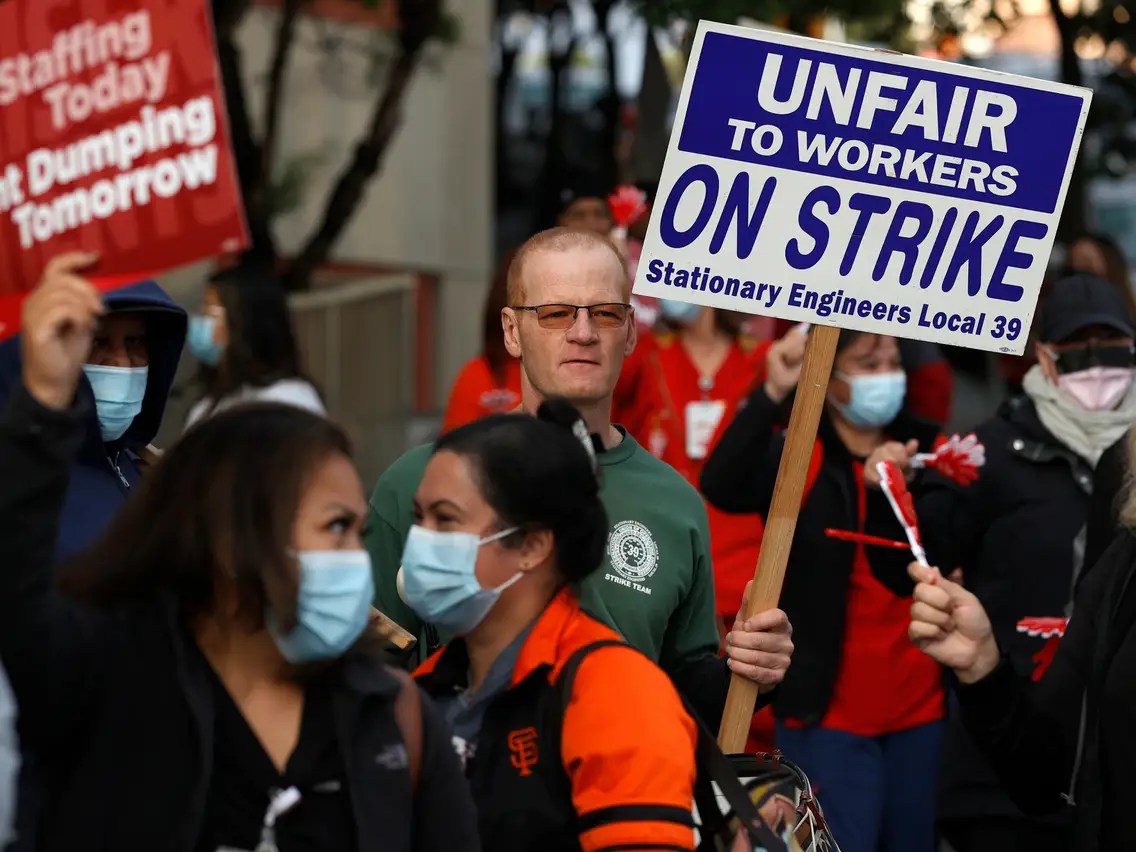
Take, for instance, the ongoing strikes by the United Auto Workers at GM, Ford, and Stellantis. These employees are demanding substantial pay increases and shorter workweeks, despite their companies already losing money and falling behind in technology and the competitive electric vehicle market.
As I have explored in my previous essays, companies like GM and Stellantis are burdened with staggering amounts of debt and minimal cash reserves. They face the Sisyphean task of scaling down internal combustion engine products, which are their only profitable ventures, while simultaneously ramping up electric vehicle production—all at a significant cash burn.
The Unsustainable Path
The current trajectory is unsustainable. If these companies capitulate to the striking workers’ demands, they may find themselves in an even more precarious financial position. Any hope of catching up in the electric vehicle market could be extinguished, necessitating more debt or a government bailout, which would, in turn, dilute existing shareholders’ stakes and perpetuate a cycle of financial instability.
Conclusion
While strikes may offer short-term gains for employees, they frequently pose long-term risks to the companies that provide them with livelihoods. The power dynamic needs a reevaluation, and the rules of engagement must be reconsidered. If not, we risk destabilizing not only individual companies but entire industries, leading one to wonder how future generations will view this era: as one of virtuous activism or misguided extortion?
Discover more from logical thinking in an illogical world
Subscribe to get the latest posts sent to your email.

