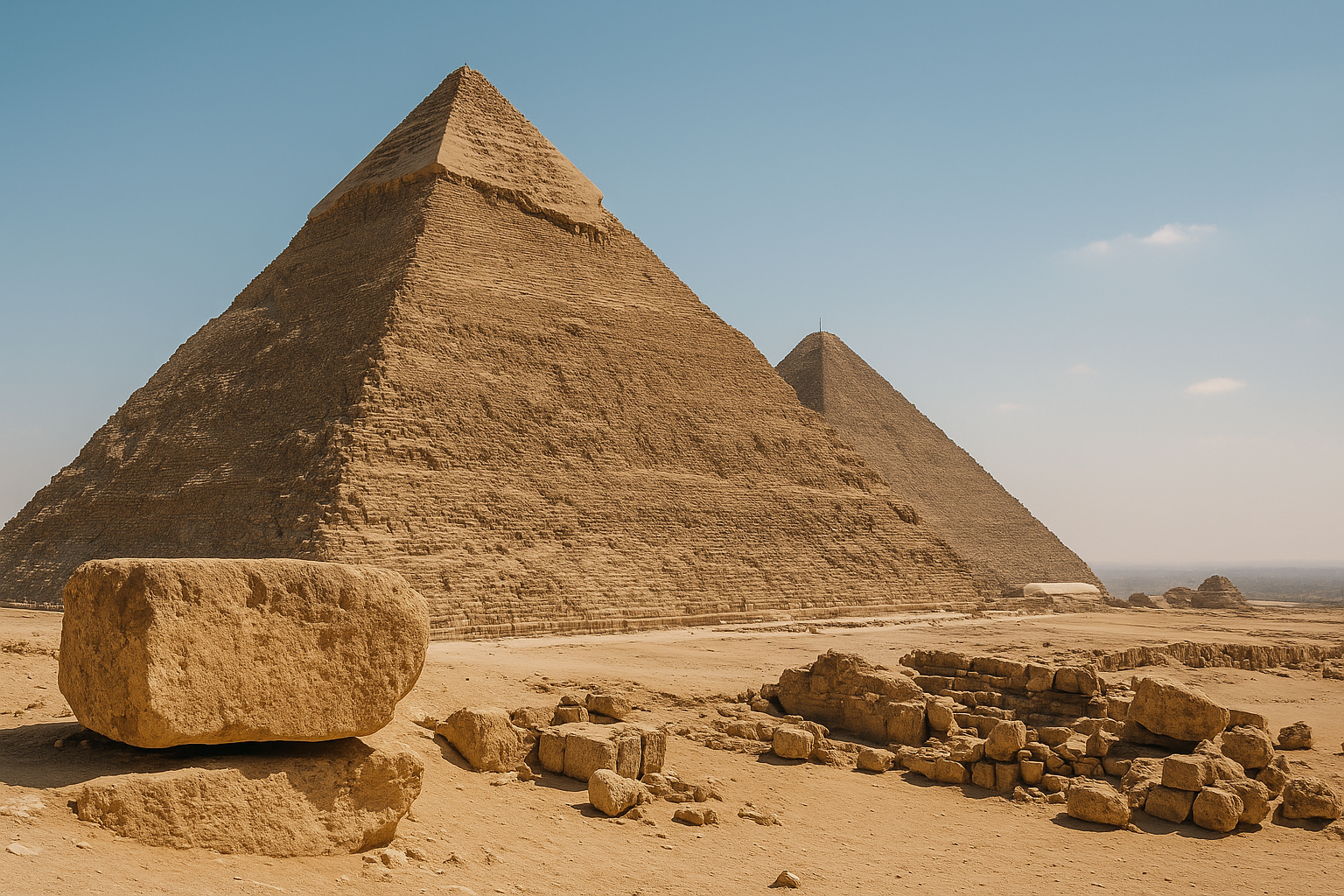

It takes a special kind of gall to look at the Great Pyramid of Giza, a structure aligned to true north within a fraction of a degree, composed of stones weighing dozens of tons each, placed with surgical precision, and claim to know, definitively, how it was built. Yet that’s exactly what many modern academics do. They wrap themselves in titles like Egyptologist and speak with the pomp of certainty, as if their degrees and peer reviews somehow transform speculation into truth.
Let’s be honest. Anyone capable of critical thought and detached observation can see that the official narrative is implausible. We’re told that a Bronze Age civilization, which supposedly didn’t yet have the wheel, pulley, or iron tools, hauled multi-ton limestone and granite blocks across the desert, lifted them hundreds of feet into the air, and placed them so precisely that even modern engineers struggle to replicate it. To call that explanation “settled science” is a greater act of faith than anything ever found in a church pew.
The Evidence That Doesn’t Fit
For starters, not a single mummy was ever found inside the Great Pyramid or any of its close architectural relatives. The “tomb” theory has always been conjecture. No soot marks line the ceilings of deep interior chambers, despite the fact that torches or oil lamps would have been required for light…unless, somehow, they had another light source. The sarcophagi are often too large to fit through the corridors that supposedly led them inside. The copper chisels and wooden sleds displayed in museum dioramas wouldn’t have lasted a single week under the stress of cutting and transporting the materials used.
Even mainstream Egyptologists admit that they cannot fully explain how certain blocks were transported, carved, or positioned. What they do instead is fill in the blanks with comforting stories, an early form of intellectual anesthesia meant to preserve the illusion of knowledge. That’s not science. That’s mythology with academic credentials.
The Pattern of Historical Arrogance
Human history is a long, embarrassing record of experts being wrong. The Earth was once flat, bleeding was once medicine, and the atom was once indivisible. The same hubris infects archaeology. Every generation assumes it’s reached the summit of understanding, only to have the next one prove it wrong.
We already know that civilizations rise and fall, and that history is often rewritten by the survivors. So why is it unthinkable that the Egyptians may have inherited these structures rather than built them? Even ancient Egyptian texts speak of gods and “previous ages,” of knowledge handed down from before the flood. Perhaps those are metaphors, or perhaps they are historical memory from a civilization far older and more advanced than we care to admit.
Humility Over Hubris
You don’t need to be a conspiracy theorist to see that the math doesn’t add up. You only need to be honest. The idea that men with bronze chisels, ropes, and ramps constructed something that still confounds modern engineering defies both logic and experience. Maybe the truth is stranger, older, and more humbling than our institutions can tolerate.
Real science is built on curiosity, not dogma. And until the so-called Egyptologists can show us…not tell us…how the Great Pyramid was built, the only thing they’ve proven beyond doubt is their own arrogance.
Discover more from logical thinking in an illogical world
Subscribe to get the latest posts sent to your email.


One thought on “The Arrogance of Certainty: How “Egyptologists” Pretend to Know the Impossible”