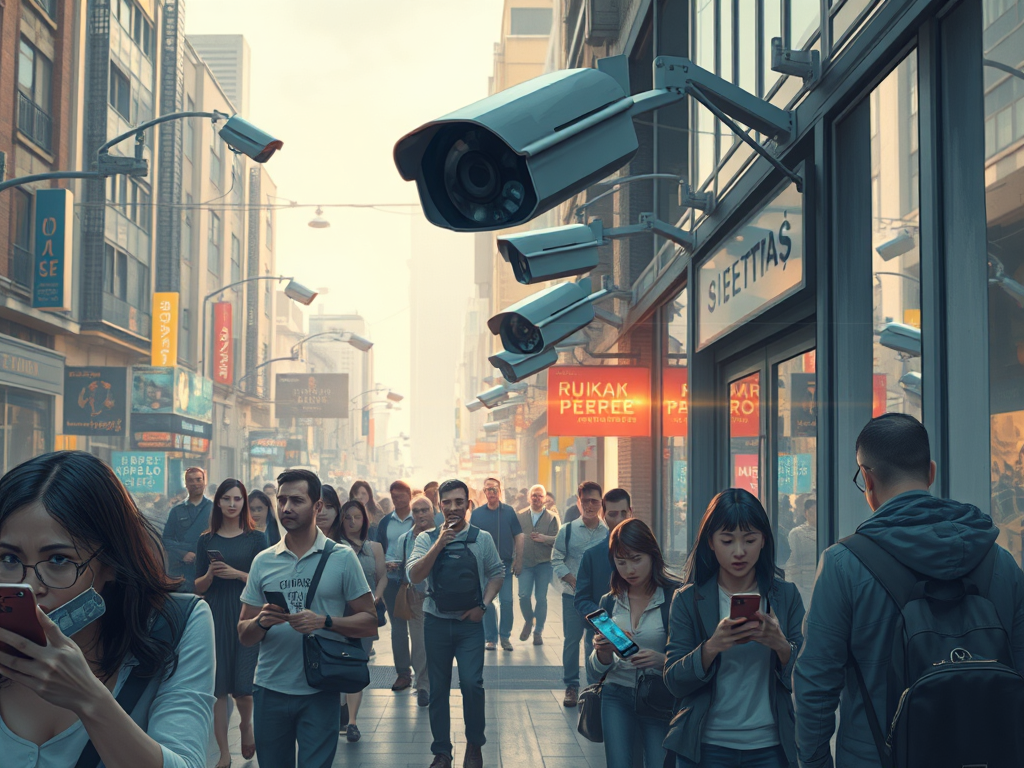

The notion of privacy in public is, frankly, a relic of a bygone age. The instant you step outside your home, you’re already visible: to people, to cameras, to satellites. Every smartphone lens, security system, and traffic cam silently records slivers of our lives. So why pretend we have an “expectation of privacy” in public? The honest answer is: legally, we don’t, and we shouldn’t.
Rather than resisting the rise of ubiquitous surveillance, perhaps we should lean into it, rationally and transparently. Imagine a future where all cameras, public, private, municipal, and residential, are linked into one vast live feed, visible to anyone. Every street corner, store, front porch, and parking lot forming part of a continuous digital fabric. In this system, you could open your phone and watch the world unfold in real time. But here’s the twist: when you do, others can see that you’re watching, and what you’re watching. No anonymous peeping, no hidden access, only radical transparency.
This idea terrifies some people. They imagine Orwell’s 1984 or the Chinese social credit system. But what if, paradoxically, transparency protects freedom? If everyone is both the watcher and the watched, power equalizes. Governments can’t manipulate footage in secret. Corporations can’t hide abuses. Criminals can’t operate unseen. We would all be accountable, equally.
And here’s the practical argument: crime would plummet. Human beings behave differently when observed. If a person knows that every passerby, from any place on Earth, can see them reaching into a stranger’s car, they won’t do it. That gold bar on the seat becomes as safe as if the window were sealed shut. When we know we are visible, we act as though our conscience has witnesses.
We already live this way online. Every post, every comment, every text has the potential to be permanent. Yet we adapt. Society didn’t collapse because our digital footprints became permanent; instead, we learned to self-censor, to think twice, to behave—at least marginally—better. Extend that logic to the physical world and you might create the first truly honest civilization.
The old argument—“If you’ve done nothing wrong, you have nothing to hide”—has long been dismissed as naïve. But what if it’s simply… true? In public, we aren’t entitled to secrecy. We are entitled to safety, fairness, and truth. If a system of linked cameras delivers those outcomes more effectively than our current patchwork of selective enforcement and blind justice, why reject it out of principle?
Yes, there are legitimate concerns. Hackers could manipulate feeds. Governments could exploit data. Privacy extremists could argue that universal surveillance kills spontaneity and erodes the human soul. But these aren’t arguments against visibility; they’re arguments for designing it ethically. The same technology that terrifies us could also deter corruption, eliminate wrongful convictions, and protect the vulnerable.
Imagine walking through a world where every act of kindness is witnessed, every theft immediately flagged, every assault impossible to hide. Civilization advances not by shielding people from accountability, but by embedding accountability into its fabric.
A society that sees itself clearly, literally, might finally behave like one worthy of being seen.
Discover more from logical thinking in an illogical world
Subscribe to get the latest posts sent to your email.


One thought on “The End of Privacy: Why Cameras Everywhere Might Save Civilization”