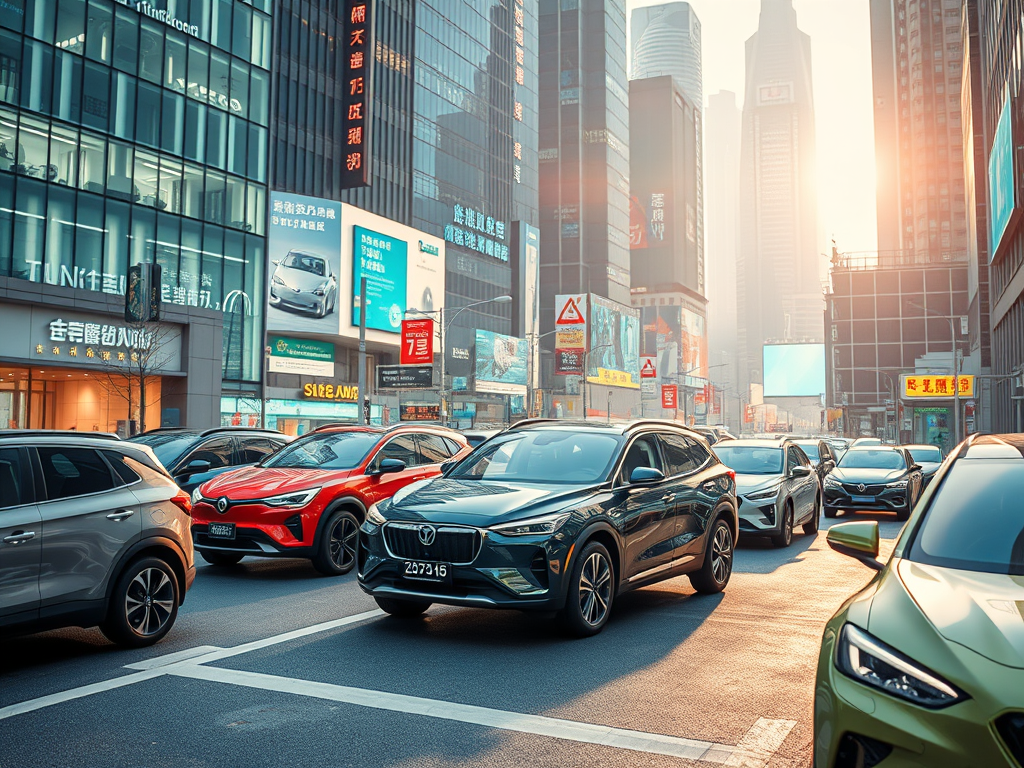

China Is Test-Driving the Future. The Rest of Us Are Still Arguing About Gas Stations.
China is not “catching up” on electric vehicles. China is the lab where the future of transportation is being built in real time while a lot of the West is still having emotional arguments about gas pumps and exhaust fumes.
If you want to know where the rest of the world is headed, you look at the largest, fastest moving market. In cars, that is China, by a mile.
1. Start with the facts: China is the car market
China is not just big, it is the center of gravity for global autos.
- In 2023, China sold around 25.8 million vehicles, over 10 million more than the United States, keeping its position as the world’s largest car market.
- In 2024, Chinese passenger car sales reached 27.56 million, and over 12 million of those were “new energy vehicles” (battery electric, plug-in hybrid, fuel cell), roughly 44 percent of all passenger vehicle sales. That alone was about two-thirds of all electric cars sold globally.
Globally, almost one in five cars sold in 2023 was electric, and the share passed 20 percent in 2024. Most of that volume is concentrated in three regions: China, Europe, and the United States. In China, the share is not “growing from a small base.” It is already mainstream.
2. China’s EV market is not a trend, it is the default
Look at what has actually happened inside China in just a few years.
- In 2024, electric cars accounted for almost half of all car sales in China, with more than 11 million electric cars sold. That is more than the entire rest of the world combined that year.
- By 2024, China’s share of global EV sales had grown to almost two-thirds, and on a monthly basis electric car sales overtook conventional car sales from July 2024 onward.
- By late 2025, “new energy vehicles” made up over 51 percent of new car sales in China in October, putting the country at roughly 49 percent NEV penetration, compared with about 7 percent in the United States.
In other words: in the largest auto market on the planet, the tipping point is not coming, it already happened. China is now a majority-electric new car market at least part of the year, and it is staying there.
When people insist that EVs are a niche product, they are not arguing with you, they are arguing with arithmetic.
3. The rest of the world will go where China goes
Car companies go where the volume is. Suppliers go where the volume is. The learning curve on batteries and power electronics gets bent where the volume is.
China now:
- Accounts for most of the growth in global EV sales and around two-thirds of EV units sold.
- Has pushed battery prices and EV manufacturing costs down globally through scale, industrial policy, and relentless competition.
There is a darkly comic side effect. Because Chinese consumers are dumping gasoline cars and buying EVs, domestic legacy automakers are stuck with excess gasoline capacity. The solution has been to export millions of gasoline cars to poorer countries that do not yet have charging infrastructure, while the home market goes electric.
So you get this odd two-tier world:
- China: majority of new sales are EVs, streets full of BYDs, Teslas, and a growing list of domestic brands.
- Large parts of Latin America, Africa, Eastern Europe: flooded with exported Chinese gasoline cars that Chinese buyers no longer want.
If you are looking for the direction of travel, it is obvious. No manufacturer is going to keep investing heavily in internal combustion for markets that are shrinking, while ignoring the one that keeps growing and dictates global scale.
4. The human side: does anyone actually like gas stations?
Strip away the culture war noise and ask simple, human questions.
- Who genuinely enjoys stopping at a gas station in the rain on the way to an important meeting?
- Who loves realizing, as they pull out of the driveway for a wedding, funeral, or job interview, that the tank is practically empty and they now have to gamble on “I think I can make it” versus turning around and wasting ten minutes at a pump?
- Who thinks “this is great” while standing in a puddle of spilled fuel, breathing fumes, holding a handle that has been touched by thousands of people?
The honest answer is obvious. No one does. At best, people tolerate it. They are used to it, which is very different from liking it.
In my 2019 essay, Imagine If Electric Automobiles Were Invented First, I made this exact point by flipping the script. I asked readers to imagine a quiet, clean, instant-torque electric world as the baseline, then have some “genius” show up and propose strapping a tank of explosive liquid to a car and filling it at smelly roadside stations as an “upgrade.”
In that framing, the gasoline car looks insane. Which is, of course, the point. Our intuitions are shaped by what we grew up with, not by what actually makes sense.
Home charging is the opposite experience of refueling with gasoline:
- You park where you already park.
- You plug in the way you plug in your phone.
- You wake up every morning with a “full tank.”
You do not run late for work because you forgot to charge. Your car charges while you sleep. Once people live with that for a year or two, the idea of scheduling detours to a gas station starts to feel as archaic as going to a video rental store on Friday night.
5. “No horse in the race” gas-station defenders
There is a particularly odd group in this debate: people who do not work for oil companies, do not own gas stations, and have no financial stake whatsoever, yet defend internal combustion like their identity depends on it.
You can understand the oil industry fighting to preserve its business model. That is self-interest. Rational, if not admirable.
You can understand a mechanic worried about losing some categories of work.
But the random person on social media who insists that:
- Going to gas stations is “no big deal”
- Oil changes are somehow a feature, not a bug
- And that EV owners are deluded, brainwashed, or part of some conspiracy
is defending wasted time, noise, fumes, and extra maintenance for free.
This is not principled skepticism. It is habit, nostalgia, and in some cases a tribal reaction to anything that smells like “change,” especially if people they dislike politically happen to support it. Meanwhile, China is not debating any of this in theory. They are just buying and driving the electric cars.
6. Virtually every aspect of EV ownership is better
Are EVs perfect? Of course not. Nothing is. You still have to build the cars, mine materials, generate electricity, and deal with end-of-life batteries.
But on the metrics that matter to actual drivers, EVs are an upgrade almost across the board:
- Refueling: from detours to gas stations to plugging in at home or work.
- Operating cost: fewer moving parts, no oil changes, cheaper “fuel” per mile in most markets, especially where electricity is relatively inexpensive.
- Performance: instant torque, smooth acceleration, quiet cabin.
- Urban environment: no local tailpipe emissions, less noise, better air.
China’s adoption curve is not driven by ideology. It is driven by cost, convenience, and policy that nudges the market toward the better technology until it can stand on its own legs. And it is already standing. Again: half of new Chinese car sales are electric. That is not a science project. That is the default.
7. The time machine effect
Look at China carefully and it starts to feel like a time machine pointed about ten to twenty years into the future of transport.
- Dense cities with large fleets of EVs.
- Public and private charging networks built at scale.
- Domestic brands that outsiders once dismissed as “cheap copycats” now leading on battery tech and software, and exporting globally.
The debate in places like the United States often sounds like this is all hypothetical. “Will EVs ever be practical?” “Can a country really run on them?”
China has already answered those questions with millions of vehicles on the road and a market that has tipped.
The more honest question for Western countries is simpler and slightly more uncomfortable:
Do we want to be the ones shaping this future, or do we want to be arguing on Facebook about gas stations while buying our next cars and batteries from companies that moved faster?
8. Where this leaves us
My 2019 conclusion was blunt: there is “no version of society advancing past 2019 where electric motors do not surpass and eventually eliminate combustion engines.”
China is the proof-of-concept that you were right, and we did not have to wait until 2119 to see it.
So, a few parting questions for anyone still clinging to the romance of the pump:
- If you could start transportation from scratch today, with today’s knowledge, would you really choose gasoline as your primary solution?
- If you had spent the last five years charging at home instead of playing “how low can the fuel light go,” would you genuinely want to go back?
- And if the largest auto market in the world has already flipped to mostly electric new sales, what exactly are you betting against when you bet against EVs?
China is not perfect, and it is not a model for everything. But on this particular question, the scoreboard is not subtle.
The future of transportation is already on the road. It just happens to have Chinese plates.
Discover more from logical thinking in an illogical world
Subscribe to get the latest posts sent to your email.

