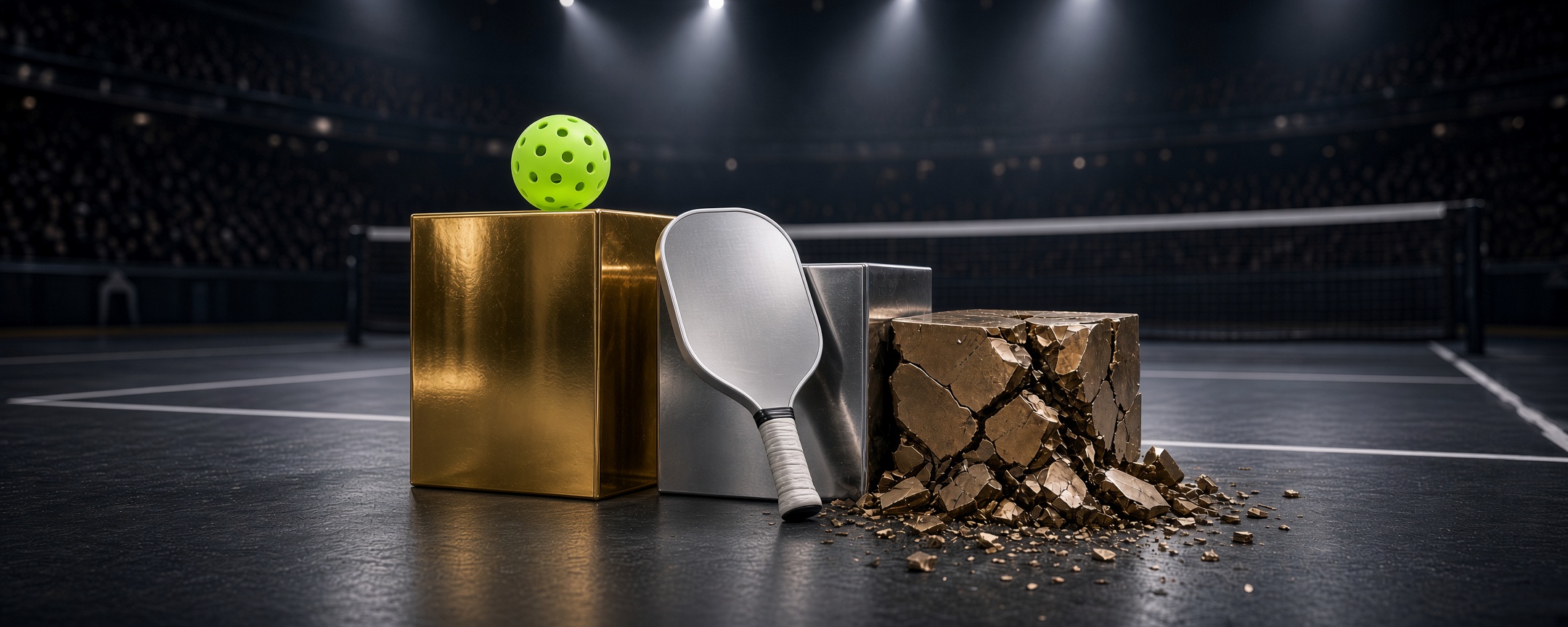

The PPA kept the branding and dropped the promise that comes with it
The @Carvana @PPAtour opened its 2026-27 season last week in Cary, North Carolina, and along with a new champion, it introduced a new problem for itself. Buried in the season’s format changes was a quiet one: no more bronze medal matches. The two players or teams who lose in the semifinals no longer play each other for third place. They just tie for it and go home.
I watched Championship Sunday. Five gold medal matches: women’s doubles, men’s doubles, mixed doubles, women’s singles, men’s singles, all starting early in the day, all decided two out of three games to 11. No bronze. The whole slate wrapped up in a few hours, which is a strange thing to say about a tour trying to convince a broadcast audience that pickleball deserves a full day of attention.
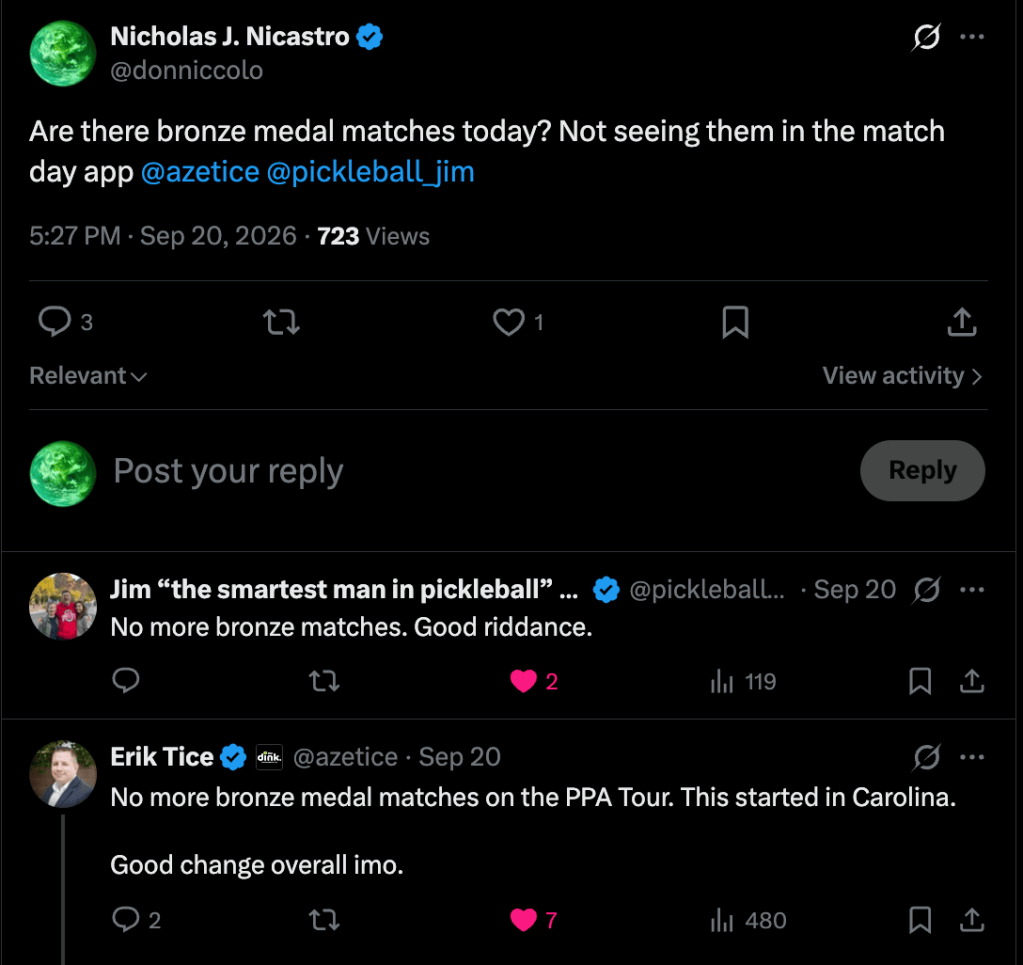
I said as much online, and Erik Tice (@azetice) GM of the Major League Pickleball’s California Black Bears (@BlackBearsCA), and writer for The Dink (@Pickleball), who covers this sport closely and knows more about its internal mechanics than I ever will, pushed back. He’d written about the change in his preview of the event, and his read was straightforward: the players didn’t like playing for bronze, the two semifinalists now earn identical points either way, and on balance it’s a good move. Fair points, made in good faith, and I want to give them their due before I explain where I still land differently.
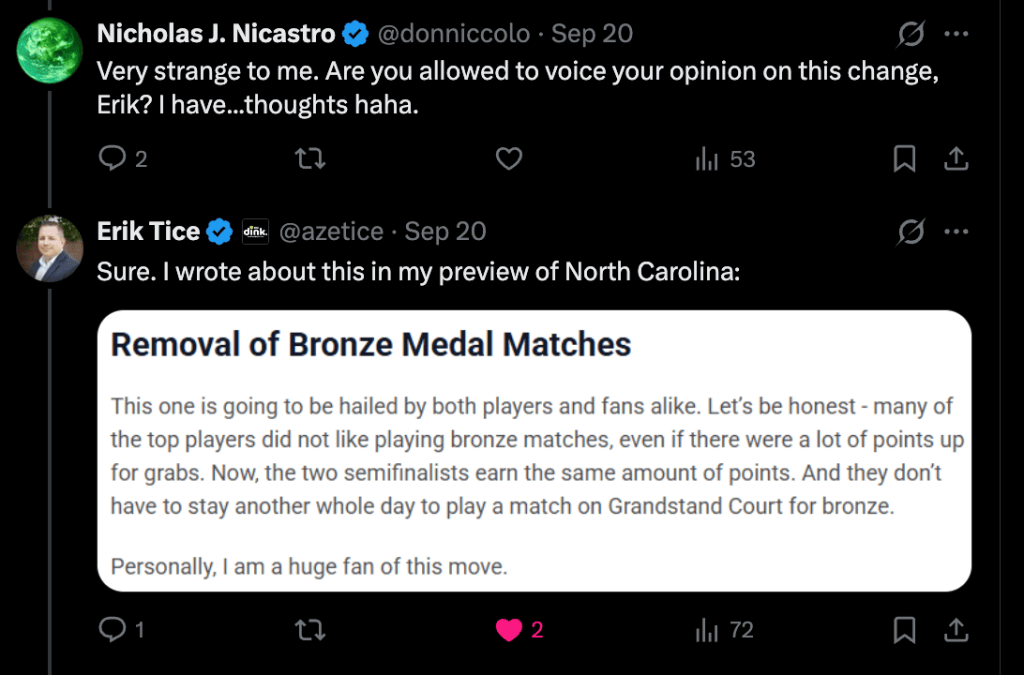
What actually changed, and why it isn’t crazy on its face
This wasn’t a snap decision. Todd Boss (@toddeboss) at Forbes Sports (@ForbesSports) has tracked the tour’s format evolution in detail, and it’s worth laying out plainly, because the history matters more than the headline.
The PPA started in 2020 with conventional double elimination, where a team could lose early and still fight all the way back to the gold match. By late 2022, the bracket tightened: semifinal winners went straight to gold, semifinal losers dropped into a consolation bracket and had to earn their way to a bronze match. By February 2023, that got simplified again, with semifinal losers going directly to bronze without the extra detour. That format produced what the tour called Super Sunday, medal rounds all day, and by most accounts it worked. Now, three years later, bronze is gone entirely.
Erik’s point about player sentiment is real, and I’m not going to pretend otherwise. Nobody has ever accused a bronze match of drawing the sport’s best effort. There’s a well-known version of this problem at the World Cup, where the third-place game has a decades-long reputation as the match nobody wants to be in, sometimes visibly. And this isn’t unprecedented at the highest level of American sports, either: the NCAA basketball tournament ran a third-place game every year from 1946 to 1981, killed it, and nobody has seriously campaigned to bring it back since. Players at the time said flatly they’d rather not play it. Cutting a game nobody enjoys playing and nobody particularly enjoys watching is not, on its own, an insane decision.
There’s also a broadcast logic behind moving every Championship Sunday match to two out of three games. A two-out-of-three match nearly always fits inside a one-hour TV window. A best-of-five can run anywhere from forty-five minutes to two hours, which is a scheduling headache for a network. I think that’s a legitimate operational concern, and I’d rather the tour say so plainly than pretend the change was purely about player welfare.
So credit where it’s due: the players’ complaint is real, the made-for-TV logic is real, and the NCAA already ran this exact experiment decades ago without regret. If the PPA had simply said “we’re retiring an unloved format, the way the NCAA did in 1981,” I’d have very little to argue with.
Where the reasoning actually breaks down
Here’s the problem. The NCAA never called its outcomes gold, silver, and bronze. Neither does tennis. Both sports crown a champion and a runner-up, full stop, and the runner-up trophy at a tennis major or an NCAA championship game is a serious, celebrated thing. Nobody at Wimbledon or the Final Four ever promised a third medal.
The PPA did. It borrowed Olympic language on purpose, presumably because “gold medal match” sounds more prestigious than “the final.” But a medal ceremony is a package deal. Once you’ve told your audience there are gold, silver, and bronze medals on the line, quietly deciding bronze doesn’t count anymore isn’t the same kind of move as tennis or the NCAA retiring a consolation game they never branded that way to begin with. It’s keeping the vocabulary while abandoning what the vocabulary promises.
It’s worth being precise about why bronze is even a question in a way silver never is. In a single-elimination bracket, second place requires no extra work at all. There’s only one final, so there’s automatically only one loser of it, and that’s your silver medalist, decided for free. Third place is structurally different. Two people lose in the semifinals. If you want to know which of them is actually better, you have to make them play again. If you don’t, they’re just tied, and tied for third is exactly what “no more bronze” produces now.
That’s a defensible outcome for a tour that calls its results champion and runner-up. It’s an odd one for a tour that still calls its results medals.
The part that actually costs someone something
Everything above is really about branding honesty. Someone who works inside the sport, and who I’ll leave unnamed because it’s not their fight to have in public, made a sharper point to me this week, one that has nothing to do with what the tour calls its results and everything to do with what the results actually determine.
Tennis has the identical tie. The ATP and WTA rankings are a season-long points system too, and two players who lose in the same Wimbledon semifinal get exactly the same ranking points, because there’s no bronze match on tour either. So this isn’t a case of tennis caring about fairness and the PPA not caring. It’s a case of the same rule landing very differently depending on the calendar around it. A tour pro plays roughly two dozen counted events a year, so one tied semifinal gets absorbed into a long season and barely moves anything. A PPA pro plays a fraction of that, with a handful of Slams carrying enormous point weight, and a single tied semifinal at one of those events can be the difference between a top seed and a play-in spot the following season.
That’s a real competitive consequence, not an aesthetic one. Reaching a semifinal by beating the third seed and losing a tight three-gamer is not the same result as sneaking through a weak quarter and then getting run off the court in the final four. Right now the standings can’t tell those two players apart, and under a schedule this concentrated, that gap actually shows up in who gets seeded where next year.
Two fixes for the branding, but only one fix for the standings
I’d take either of these for the sake of honesty:
Play a real bronze match. It doesn’t need to be a full best-of-three ordeal that punishes players for the sin of losing a close semifinal. A single game to 15 would settle it in twenty minutes and give Championship Sunday a sixth match, which happens to be the exact thing fans actually want more of (though personally, I would prefer a best-of-three). Erik’s underlying point stands here too: nobody needs to make players suffer through a full match for the privilege. Make it short. Just make it real.
Or drop the medal language entirely. Call it a champion and a runner-up, the way tennis and the NCAA do, and stop implying a third tier exists. This one is worth being honest about its limits, though: it fixes the promise you’re making to fans, but it does nothing for the standings. Semifinal losers would still tie on points, the same way they do in tennis today. If the tour only wants to solve the branding problem, this works. If it wants to solve the actual competitive one, it doesn’t.
Between the two, I’d play the match. It’s the only fix that touches both problems, and it costs the tour twenty minutes of TV time it can easily find somewhere else in the day. Plus, does not the PPA want more TV time, not less?
What I don’t think works is the version the tour actually chose: keep saying gold, keep implying bronze, and just stop deciding who gets it, on a tour where that decision follows a player into next season’s seeding. That’s not streamlining a broadcast. That’s advertising a medal stand with two steps and hoping nobody counts, on a leaderboard where the missing step actually changes who plays whom next year.
This is a small decision in the scheme of a sport that just posted some of its best numbers ever. But it rhymes with something I wrote about a few weeks back regarding Major League Pickleball, which now shares a holding company with the PPA. Different tour, same instinct: a tweak gets made for a sensible operational reason, and nobody sits with it long enough to notice what it quietly breaks somewhere else. The PPA and MLP are both good products being run, in places, like a Tuesday afternoon meeting decided them. Small, fixable things. That’s the whole point of writing about them.
Nick Nicastro @donniccolo
Sources: PPA Tour, Pickleball.com, The Kitchen Pickle, Forbes (Todd Boss), NCAA tournament history. Credit to Erik Tice of The Dink for the on-the-record exchange that shaped this piece; his reporting is second to none.
Discover more from logical thinking in an illogical world
Subscribe to get the latest posts sent to your email.

