
(originally published on X Articles, May 24, 2024)
Religious institutions in the United States enjoy property tax exemptions, a privilege that costs taxpayers billions of dollars annually. This essay argues for the necessity of abolishing these exemptions, emphasizing the potential benefits to society and the principle of fairness.
Why We Must Challenge Religious Tax Exemptions
Religious institutions occupy vast amounts of valuable real estate, contributing little to public revenue while benefiting from public services. In many communities, these properties are prime locations that could otherwise generate substantial tax income. By taxing religious properties, municipalities could fund public services, infrastructure, and community programs, potentially alleviating budgetary constraints.
The Financial Impact
Cursory research indicates that taxing religious properties could generate approximately $200 billion annually. This revenue could be allocated to various public sectors, including education, healthcare, and social services, directly benefiting citizens and enhancing the quality of life in communities across the nation. Alternatively, property taxes of ordinary citizens, both sacred & secular, could be reduced by approximately $200 billion annually!
Fairness and Equity
The current tax-exempt status of religious institutions creates an imbalance, placing a greater tax burden on non-religious property owners. This exemption also implicitly endorses religious entities, conflicting with the constitutional principle of separation of church and state. By requiring religious institutions to pay property taxes, we uphold fairness and ensure that all property owners contribute equitably to the community.
Addressing Counter Arguments
Opponents argue that taxing religious institutions infringes on religious freedom and could financially cripple these organizations. However, paying property taxes does not impede religious practice; it merely requires these institutions to contribute to the public services they utilize. Furthermore, many religious institutions possess significant wealth and can afford to pay property taxes without compromising their operations.
Further & Better Examples
For a deeper dive into this topic, I previously explored the issue of taxing religious institutions in my essay, “It’s Time For Churches To Pay Taxes”. In that essay, I discussed how the tax exemptions for churches directly impact taxpayers and highlighted the absurdity of subsidizing religious institutions that often hold vast amounts of wealth. Revisiting this topic now, in the information age, further underscores the need for a critical evaluation of these exemptions and the significant financial burden they impose on all taxpayers.
Required Reading: Christopher Hitchens
In my recent #RequiredReading series entry, I discussed Christopher Hitchens’s seminal work, “God is Not Great”. Hitchens eloquently critiques organized religion and its detrimental impact on society, underscoring the irrationality of religious beliefs. This perspective aligns with the argument against tax exemptions for religious institutions, as it highlights the absurdity of subsidizing entities that contribute to societal harm rather than benefit. For anyone seeking a deeper understanding of the issues with theism and religious privileges, Hitchens’s book is an essential read.
Potential Benefits of $200 Billion Annually
The potential annual revenue of $200 billion could have a transformative impact on society:
• Public Services: Increased funding for public schools, libraries, and emergency services.
• Healthcare: Enhanced healthcare services and reduced medical costs for citizens.
• Infrastructure: Improvements in transportation, roads, and public utilities.
• Economic Stimulation: Putting money back into the hands of citizens through basic trickle-down economics, increasing disposable income and stimulating the economy. In other words: MORE MONEY IN YOUR BANK ACCOUNT!
Personal Anecdote/Example
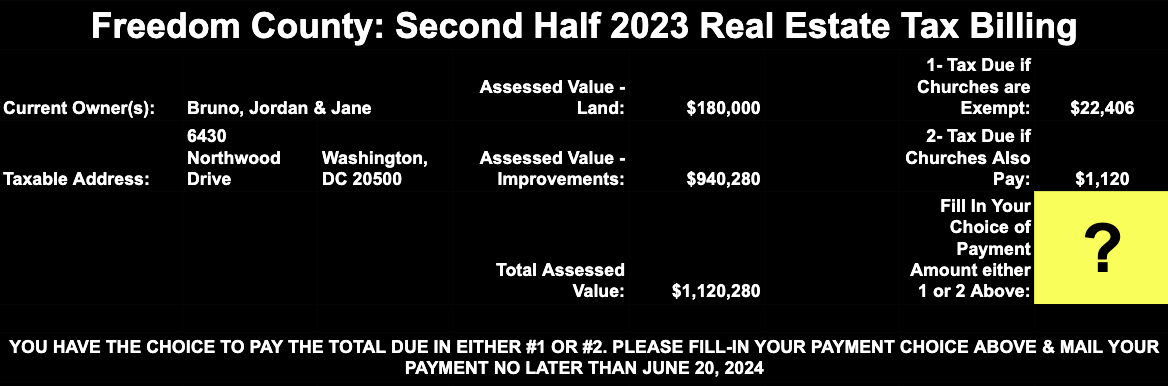
To provide a visceral example, we use a hypothetical tax detail screen from a fictitious county. This example illustrates the significant difference in property tax bills if churches paid their fair share. The calculations show how much less individuals would have to pay, demonstrating the direct financial benefit to taxpayers.
Call to Action
I challenge readers to consider the fairness and logic behind the current exemption. It’s time to acknowledge that subsidizing religious institutions at the expense of taxpayers is not only unfair but also detrimental to societal progress. While a perfect solution would be to abolish the archaic & inhumane idea of taxing land & property, short of that, I propose advocating for policy changes to tax religious properties, ensuring that everyone pays their fair share.
Conclusion
Abolishing property tax exemptions for religious institutions is a step towards fiscal responsibility and fairness. By contributing to public revenue, these entities would help support the communities they claim to serve, fostering a more equitable and prosperous society. The potential tax revenue could significantly impact public services, benefiting all citizens and ensuring that everyone pays their fair share.
Discover more from logical thinking in an illogical world
Subscribe to get the latest posts sent to your email.

