
I was raised Catholic. Not casually Catholic. The full program. Church. Altar boy. First communion. Confirmation. The whole carefully choreographed production.
As a child, none of it seemed strange. Children rarely question the stories handed to them by trusted adults. If everyone around you speaks with certainty, certainty becomes the default setting.
Then adulthood arrives. Curiosity arrives. Critical thinking arrives.
And suddenly the story begins to wobble.
Not because of malice. Not because of rebellion. Simply because the questions that apply everywhere else in life begin to creep into the one area where questions are quietly discouraged.
Here is the question that never left me.
How can the most worshipped human being in history have almost no documented life?
Let us be precise.
According to the canonical gospels, Jesus is born around 6 to 4 BCE. The narrative then jumps to a single childhood story. At age twelve, he is found in the Temple, astonishing scholars with his wisdom.
And then he disappears.
Not metaphorically. Not spiritually. Literally disappears from the historical record.
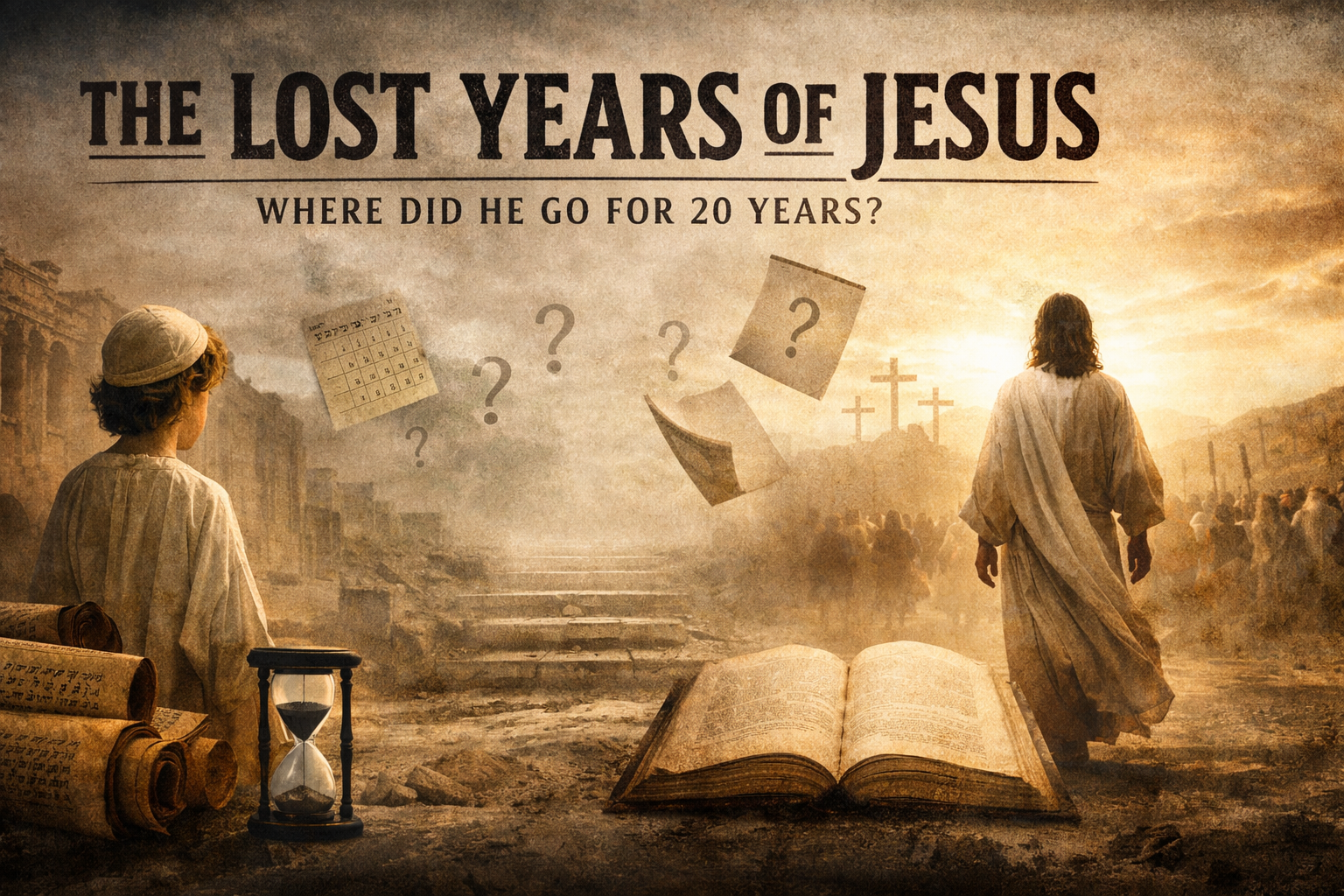
From age twelve until roughly age thirty, there is silence. Eighteen to twenty years. Gone.
No teachings. No travels. No sermons. No miracles. No letters. No contemporary accounts. No historians tracking his movements. Nothing.
Then suddenly, at around age thirty, he reappears as a fully formed preacher launching a public ministry that lasts perhaps three years before his execution around age thirty-three.
That is the biography of the central figure of Christianity.
Birth.
One childhood anecdote.
Twenty-year blackout.
Three-year ministry.
Execution.
Resurrection claims.
This is not an atheist talking point. This is mainstream Christian scholarship. The gap has a name. It is called the “Lost Years of Jesus.”
Pause and imagine applying this standard anywhere else.
Imagine a historian presenting the biography of Julius Caesar but skipping from middle school to the invasion of Gaul. Imagine a biography of Einstein that omits his twenties. Imagine a biography of Abraham Lincoln that jumps from adolescence to the presidency.
We would laugh. We would demand sources. We would insist on evidence. We would ask who wrote the account, when it was written, and what agenda might have shaped it.
Yet when the subject is religion, the usual rules of skepticism evaporate like morning dew.
Why?
The gospels were written between roughly 65 and 100 CE, decades after the events they describe. They were not written as modern historical biographies. They were theological documents written by believers for communities of believers. Their goal was persuasion, not documentation.
This matters.
Ancient writers did not approach history the way we do. They wrote to inspire, to teach, to persuade, to unify communities. Accuracy was often secondary to meaning. Stories were shaped to convey truth as the authors understood it, not necessarily truth as modern historians would define it.
Even many theologians acknowledge this openly. The gospels differ on timelines, events, and details. They contradict each other in places. They were selected, edited, and canonized centuries later by church authorities deciding which texts counted and which did not.
Thousands of early Christian writings did not make the cut.
This is not conspiracy theory. This is church history.
Councils debated. Texts were chosen. Texts were excluded. The canon was curated.
Yet billions of people treat the final edited collection as a flawless transmission of divine truth.
We would not accept this level of evidentiary thinness in medicine. In law. In journalism. In science. In finance. In archaeology. In engineering.
But in theology, the bar drops through the floor.
And here is the uncomfortable part.
This gap in Jesus’ life is not a minor detail. It is the majority of his life. Roughly 85 percent of it is undocumented.
We know almost nothing about the daily life, education, relationships, work, travels, or development of the man billions worship.
He enters the narrative fully formed, already wise, already authoritative, already miraculous.
This is not how real biographies look. This is how mythic narratives look.
Which raises a profoundly human question.
If this story had been presented to us as adults, without childhood conditioning, would we accept it without scrutiny?
Or would we ask the obvious questions?
Where are the records?
Who wrote this?
When was it written?
What was left out?
Who decided what counted?
Why is the largest portion of the life missing?
These are not hostile questions. They are the most basic questions of intellectual honesty.
And here is the twist that makes the entire situation deeply ironic.
The moral teachings attributed to Jesus often align beautifully with secular humanism. Compassion. Forgiveness. Generosity. Care for the poor. Love your neighbor. Treat others as you wish to be treated.
These are not uniquely Christian ideas. They are deeply human ideas. Versions of them appear across cultures, philosophies, and civilizations long before Christianity existed.
Morality did not begin two thousand years ago. It evolved with human societies. Cooperation and empathy were survival traits long before they were commandments.
You do not need ancient texts to tell you that kindness is better than cruelty. You do not need divine authority to recognize that empathy improves the human condition.
In fact, removing the supernatural framework often strengthens the moral message. When kindness is chosen without the promise of heaven or the threat of hell, it becomes something far more meaningful. It becomes genuinely human.
And perhaps that is the quiet realization waiting beneath the surface of this entire conversation.
We can be good without mythology.
We can be moral without ancient authority.
We can pursue truth without fear.
We can value compassion because it improves human flourishing, not because it is commanded.
The world does not become darker when we question inherited stories. It becomes clearer.
The real miracle is not that ancient texts exist. Humans have been writing stories for millennia.
The real miracle is that we are capable of asking better questions than the generations before us.
And perhaps the most honest tribute to the moral teachings attributed to Jesus is not uncritical belief.
It is the courage to seek truth, wherever it leads.
Discover more from logical thinking in an illogical world
Subscribe to get the latest posts sent to your email.

