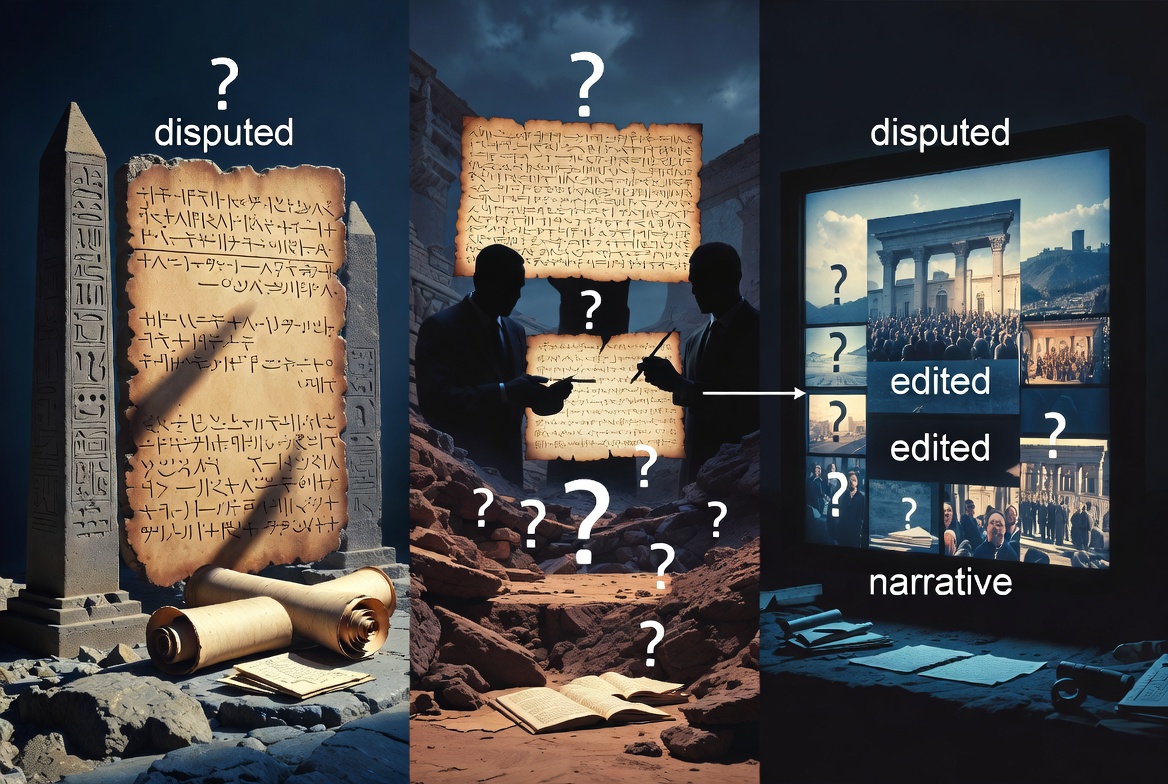

Here is a question worth sitting with before we go any further.
If you can watch the most powerful governments on Earth manipulate narratives, suppress inconvenient facts, and rewrite events in real time, right now, in the age of smartphones and social media and instant global communication, what exactly makes you think they were not doing the same thing five hundred years ago? Or a thousand? Or five thousand?
The answer, if you are being intellectually honest, is nothing. Nothing makes you think that at all.
And yet, open virtually any history textbook, sit in virtually any university lecture hall, or watch virtually any documentary about ancient civilizations, and you will find a remarkable degree of confidence about what daily life looked like for people who died before the printing press existed. What they believed. What they built and why. What their leaders intended. What their wars were really about.
This confidence is not earned. It is performed. And we should stop applauding it.
We Can See the Bias Right Now
Let’s start with the present, because the present is the only place we actually have receipts.
Today, in 2026, we have governments on every continent actively shaping the historical record as it is being written. They classify documents. They control school curricula. They fund certain research and defund other research. They prosecute journalists. They build monuments to some figures and quietly erase others. Every political party in every country on Earth tells a version of history that happens to justify their current positions and flatter their current leaders. This is not a conspiracy theory. This is a documented, observable, ongoing reality.
As I have written about before, all politicians are, to some degree, fooling you. That is not cynicism. It is pattern recognition.
Now here is the question that should logically follow: if this is happening today, with cameras everywhere, with independent journalism, with whistleblower laws and opposing political parties and international watchdog organizations all working to check the powerful, how much worse was it when none of those safeguards existed?
The answer is obviously, dramatically, undeniably worse.
Kings wrote their own histories. Emperors burned libraries. The Catholic Church spent centuries controlling what information was preserved and what was destroyed. Victorious armies razed the records of defeated ones. The idea that the ancient historical record survived all of this intact and unbiased is not a scholarly position. It is an act of faith.
Dead Languages and the Translation Problem
Here is something academics do not say loudly enough.
You cannot definitively translate a dead language.
You can make educated guesses, often very good ones. You can cross-reference symbols and contexts. You can build on the work of prior scholars. But when the last native speaker of a language has been dead for two thousand years, every translation is, at its core, an interpretation. Layer those interpretations across centuries of scholarly work, each generation building on the assumptions of the last, and what you have is not a window into the ancient world. You have a very long game of telephone, played by people with their own cultural assumptions, funding pressures, and ideological commitments.
When someone tells you confidently what an ancient Egyptian pharaoh believed, or what a Sumerian text meant, or what a Roman senator intended by a particular phrase, the honest response is to ask how they know. Not to be difficult. But because that is the right question.
The Dinosaur Problem
For most of the twentieth century, science told us that dinosaurs looked like enormous, scaly reptiles. Cold-blooded. Slow. Reptilian in every way.
We now believe that many of them had feathers.
This is not a minor revision. This fundamentally changes what these creatures looked like, how they behaved, and how they relate to modern birds. And this correction came from fossil evidence that was always in the ground, waiting to be found and correctly interpreted.
Here is the uncomfortable implication: for decades, experts were confidently wrong. Not lying, not guessing wildly, but genuinely, systematically, peer-reviewed wrong.
Now apply that logic to human history. If we can be that confidently mistaken about creatures whose bones we can physically hold, whose existence predates humans by tens of millions of years, how confident should we be about the internal motivations, daily routines, and cultural practices of human civilizations that existed three thousand years ago? Civilizations we know primarily through texts that were selected, translated, and interpreted by people with their own agendas?
The humility that the dinosaur revision should produce in all of us does not show up nearly enough in historical scholarship.
Even Video Evidence Gets Disputed
If you need a final data point, consider this. We live in the most documented era in human history. We have video of virtually everything. And still, major events are disputed in ways that serious people cannot resolve. The Kennedy assassination is the obvious example, something I have explored before here. Footage exists. Witnesses exist. A government commission investigated and issued a report. And decades later, a meaningful percentage of Americans, including many credentialed researchers, believe the official account is incomplete at best.
This is not ancient history. This is within living memory. With cameras.
If documented events from sixty years ago, in a modern nation-state, with preserved film and thousands of living witnesses, can remain genuinely contested, what does that tell us about our confidence in what Julius Caesar was actually thinking, or what the builders of the pyramids actually believed, or what daily life in ancient Mesopotamia was genuinely like?
It should tell us to hold all of it more loosely.
The Point Is Not Nihilism
To be clear, none of this means we should abandon the study of history. Quite the opposite. History is fascinating precisely because it is a puzzle we are perpetually reconstructing with incomplete pieces. The archaeological record tells us real things. Patterns emerge. Reasonable inferences can be drawn.
But there is a significant difference between reasonable inference and settled fact. Between educated interpretation and confident declaration. Between a working theory and an established truth.
As I argued in Do You Care About Truth or Winning?, truth should be the objective of every serious intellectual conversation. And truth requires honesty about the limits of what we actually know. My recent essay on Not All Opinions Are Created Equal makes the case that expertise deserves weight. But expertise paired with false certainty is still false certainty.
The honest scholar says: here is what the evidence suggests, here is how confident we should be, and here is what we still do not know.
The dishonest one says: here is what happened.
A thousand years from now, someone will look back at what we confidently believed about ancient civilizations and shake their head, much the way I shake mine at the featherless dinosaur, the flat earth, the geocentric solar system, and every other thing that the smartest people of their era treated as settled.
That is what #100years is all about.
The least we can do is have the intellectual honesty to admit it while we are still here.
Discover more from logical thinking in an illogical world
Subscribe to get the latest posts sent to your email.


One thought on “History Is a Theory. Start Treating It Like One.”