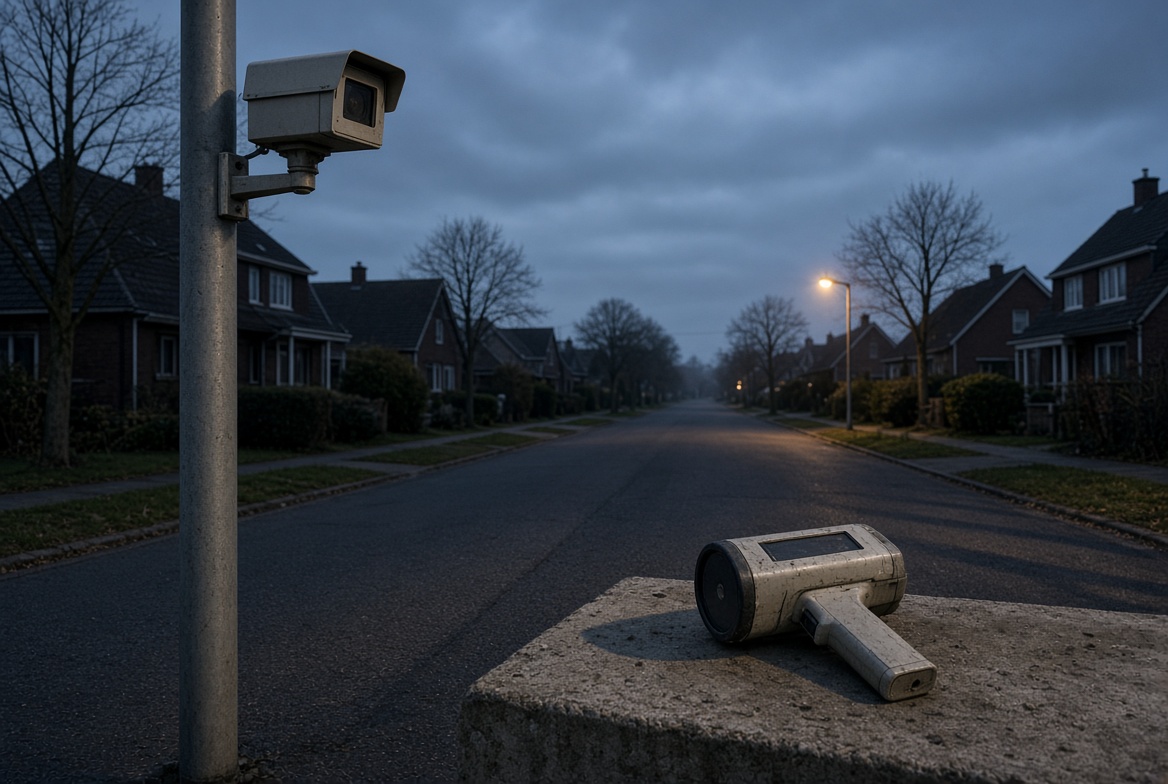

We had to run down to Canal Winchester recently, and on the way back I started counting police cruisers parked in medians and behind overpasses running radar. I got to ten before we hit the outerbelt.
Ten officers. Ten cars. Ten salaries, ten pensions, ten sets of equipment, all dedicated to catching a rounding error’s worth of the people who sped past them that afternoon. A radar gun catches one car at a time. On a corridor moving thousands of vehicles an hour, that is a rate of enforcement so close to zero that we may as well call it a lottery.
We have the technology to make it close to one hundred percent. We have had it for twenty years. We decided not to use it.
Meanwhile, on that same drive, we passed cameras that photographed our license plate, timestamped it, geotagged it, and filed it in a searchable database maintained by a private company, which police can query without a warrant.
Nobody voted on that one. And I would like someone to explain to me how both of those things can be true at the same time.
What Ohio Actually Did
I want to get the facts right here, because this is a case where the real history is more damning than the vibe.
Ohio has spent more than a decade systematically dismantling automated traffic enforcement. In 2015, the legislature passed Senate Bill 342, which effectively required a law enforcement officer to be stationed at each camera location. That single provision destroyed the economics of the programs, and cities began pulling cameras out.
Then the cities sued, and they won. In 2017, the Ohio Supreme Court ruled 5-2 in Dayton v. State that the officer requirement and the rest of the 2015 restrictions violated the home-rule authority the Ohio Constitution gives municipalities. On the merits, in front of the state’s highest court, the legislature lost.
It did not accept the loss. It changed weapons.
A provision in the 2019 transportation budget allowed the state to deduct from a municipality’s local government fund, dollar for dollar, whatever it collected in traffic camera fines. Newburgh Heights and East Cleveland sued, arguing the state was making photo enforcement deliberately unaffordable. In May 2022, the Ohio Supreme Court upheld the law unanimously. Justice Sharon Kennedy wrote that the Ohio Constitution does not require the General Assembly to appropriate anything to municipalities in the first place.
Cities got the message. Dayton, which kept its program running on principle, watched its first monthly deduction come in at over six hundred thousand dollars.
Then in 2025, the transportation budget went further and barred Ohio counties and townships from operating traffic camera programs at all.
And the state is not finished. A bill introduced in the Ohio Senate this session would require a city to put its camera program to a public vote before running one. Notice the asymmetry. Voters may soon get a say over the camera that catches red light runners. Nobody has proposed asking them about the one that logs everyone.
That is not ambivalence. That is a sustained, decade-long, bipartisan-in-effect campaign to make sure that a machine capable of catching nearly every red light runner in the state is not permitted to do so.
What Ohio Did Not Do
Now hold that next to the other thing.
Automated license plate readers, most prominently the ones made by Flock Safety, have spread across Ohio and the country with almost none of that scrutiny. They photograph every plate that passes, build a searchable history of where your vehicle has been, and make that history available to law enforcement without a warrant.
The courts have almost uniformly said this is fine. Appellate and federal district courts in at least fourteen states have upheld warrantless ALPR evidence, as have the Ninth and Eleventh Circuits. A Virginia circuit judge briefly ruled the other way in 2024, and the Virginia Court of Appeals reversed him in October 2025, holding that photographing a plate on a public road did not require a warrant.
The Institute for Justice brought the strongest challenge, in Norfolk, on behalf of two residents. In four months, the city’s network had captured one of them 475 times and the other 325 times. A federal judge upheld the program in a fifty-one page opinion, reasoning that the plaintiffs could not show the system was capable of tracking the whole of a person’s movements. The Institute for Justice appealed, and the Fourth Circuit has tentatively scheduled oral argument for the week of December 8. I will be watching.
So here is the scoreboard. The technology that catches you doing something you actually did, at a specific moment, in a way you can look at on a photograph, was legislated nearly out of existence in Ohio. The technology that records where everyone has been, including the overwhelming majority of us who did nothing at all, sailed through the courts and got installed while most people were not paying attention.
Make that make sense.
The Best Argument Against Me
I am not going to pretend the other side has nothing. It has quite a lot, and I would be doing the thing I criticized in Do You Care About Truth… or Winning? if I skipped it.
The case for banning speed cameras while permitting plate readers goes roughly like this.
Traffic cameras were a revenue operation wearing a safety costume. Cities placed them where the money was, not where the crashes were. Yellow light timing became a budget input. Dayton reported that three quarters of the fines it collected were outside school zones, which is not the profile of a child safety program. The incentive structure was corrupt in a way that had nothing to do with the technology itself.
Second, and this is the stronger point, there is a genuine due process problem. A camera photographs a car. A citation goes to the registered owner. But the registered owner may not have been driving. Ohio courts have handled class actions from people ticketed as owners who were not behind the wheel. Automated enforcement quietly inverted the presumption of innocence and turned a moving violation into something closer to a parking ticket with a much larger fine.
Third, ALPR gets sold as a fundamentally different product. It is not pitched as an enforcement tool at all. It is pitched as an investigative one. Find the stolen car. Find the abducted child. Find the shooter’s vehicle. Nobody gets a ticket in the mail from a Flock camera. The system sits dormant until a human being with a badge has a specific reason to query it, and the courts have leaned heavily on that distinction, along with short retention windows and the limited number of cameras.
That is a real argument, honestly stated. If you hold it, you are not a fool.
Where It Falls Apart
But I think it collapses under two pressures, and the second one is fatal.
The first is the logic of the inversion itself. Strip away the packaging and look at what each system observes. A speed camera observes a discrete act, committed by a person, in violation of a law, at a known time and place. It observes guilt. A plate reader observes everyone, most of whom have committed nothing, and retains that observation on the theory that it might become useful later.
We banned the narrow tool and blessed the broad one. If your objection to automated enforcement was that it was too aggressive toward citizens, you got the outcome exactly backward. If your objection was revenue extraction, you have accidentally revealed that your concern was never surveillance. It was the invoice.
That is worth sitting with. When the legislature tried to restrict cameras through ordinary law, the Supreme Court struck it down. Its remedy after that was purely financial. Not constitutional, not privacy-based. Dollar for dollar, deduct what they collect. The state never said cameras violate your rights. It said cities may not profit from them. Those are extremely different objections, and only one of them has anything to do with liberty.
The second pressure is that the investigative-not-enforcement distinction is already dissolving. In December 2025, Georgia State Patrol issued a ticket to a motorcyclist for holding a cell phone. The citation reportedly noted that the violation was captured on a Flock camera.
There it is. Not a stolen car. Not an abduction. A traffic ticket, generated from a surveillance network that was sold to the public on the explicit promise that it would not be used to generate traffic tickets.
This is the part I want people to understand, and it is not a paranoid point. It is a structural one. Once the infrastructure exists, the use case expands to fill it. It always does. The promise about what a system will be used for is made by the people installing it, and it is not binding on anyone who comes after them. We did not vote for the cameras. We certainly did not vote for whatever they get pointed at in 2031.
Washington became the first state to pass a law restricting ALPR access, barring its use for immigration enforcement, protected health care tracking, and First Amendment activity. The existence of that statute tells you those uses were live enough to legislate against.
Reconciling This With Myself
Now, some of you have read what I wrote in The End of Privacy: Why Cameras Everywhere Might Save Civilization, and you are already typing. Fair enough. Let me square it, because I think the squaring is the most important paragraph in this essay.
I argued there that a fully transparent world, one where everyone is both the watcher and the watched, could make crime close to obsolete. I still believe that. But read the condition again. Everyone is both the watcher and the watched. Symmetry is not a decorative detail of that argument. It is the entire load-bearing wall.
Flock is not symmetry. Flock is a one-way mirror. The citizens are recorded. The recording is held by a private vendor. The query log is not public. The people doing the querying are not themselves subject to the system in any comparable way. That is not transparency. That is asymmetry with a transparency brochure.
I want the cameras. I have said so and I will say it again. I want them pointed at everyone, including and especially at the people operating them, with the queries logged and public and auditable. A world where every enforcement action is recorded and every record is reviewable is a world I would sign up for tomorrow. That is not what we built. We built the half that watches you.
What Consistency Would Actually Look Like
There are two coherent positions here, and Ohio holds neither.
Position one. Automated enforcement is legitimate. Then let the cameras enforce, at scale, and fix the actual problems. Send the fine to the driver, not the owner, using the same facial and vehicle recognition the surveillance side already deploys. Route every dollar away from the enforcing municipality so the revenue incentive dies. Publish the placement criteria and the crash data behind them. Log every database query, permanently, and make the log public. Then, when nearly every violation gets caught, watch what happens to behavior. You do not need ten cruisers in medians if speeding reliably costs money.
Position two. Automated dragnet observation of ordinary people is not something a free society does. Then say that, and mean it, and apply it to the plate readers too. Take them down. Go back to officers and radar guns and a two percent catch rate and accept that the price of privacy is imperfect enforcement, which is an honorable trade and always has been.
What we have instead is the worst available combination. Enforcement that barely works, run by expensive humans doing a job a machine does better, and observation that works extremely well, run by a private company on behalf of everyone and accountable to almost no one. We got the inefficiency of the old system and the surveillance of the new one, and we are paying for both.
The Part That Makes This Temporary
There is one more thing, and it is the reason I am not especially gloomy about it. The entire speeding enforcement apparatus has an expiration date. I wrote in Tesla Is Sitting on a Gold Mine It Has Not Noticed Yet about how much a modern fleet already knows about road conditions, and I have made the broader case for autonomy in You Think Gas Cars Are Better Than Electric. You Are Wrong.
An autonomous vehicle does not speed. It does not run red lights. It does not roll stop signs because it is late. When the fleet turns over, the entire enforcement question dissolves, along with a meaningful share of what those ten officers were doing in those medians. I made a related argument in Guns Should Be the Exception, Not the Rule for Police: most of what we ask armed officers to do is work that technology can do more safely, and the profession will be better when it stops being asked to do it.
So the traffic camera fight will end on its own. The surveillance question will not. Long after the last radar gun is in a museum, the database will still be there, still growing, still queryable, still holding the record of where you went on an ordinary Tuesday in 2026 when you had done nothing wrong at all.
That is the fight worth having. And the strange, slightly embarrassing truth is that we spent a decade fighting the other one. Being the adult in the room sometimes just means noticing which argument you were having, and asking whether it was the one that mattered.
Discover more from logical thinking in an illogical world
Subscribe to get the latest posts sent to your email.

